

I use artificial intelligence, namely Claude, to help me run my photography business. And I teach people how to use it in similar ways at Truckee Meadows Community College’s adult learning program. Without Claude and my project management tools, I don’t think I would have made $100,000 in my first year in business.
But I use it in very thoughtful, often laborious, and specific ways that I don’t think people are really talking about in the mindlessly repetitive hot takes I read on social media — which are often written by ChatGPT (ps, I’ve been using em dashes since middle school).
Claude helped me brainstorm an outline for this article, but it is 100% written by a grass-fed human and his nimble little human fingers.
Let me break down my personal DOs and DON’Ts of AI as a creative-industry business owner, both to be accountable to my clients and to try to break through the binary, surface-level thinking I’ve read over the last six months.
Ways I DO use Claude for my business
As a Sales Assistant
In 2025, I started using AI exclusively for sales management, tracking, and proposal building. From there, I expanded some of my uses and created a framework for all the below.
My sales assistant, coupled with my project management and CRM tool (Bonsai), helps me keep tabs on conversations with potential clients and helps me write proposals. When I first started my business, sales and pricing were my weakest skills. I didn’t really know how to communicate my value to clients or what I could charge. My background in journalism makes me pretty direct, and I never really learned how to explain what I do, especially in a way that would get people to pay me for it.
Together, Claude and I created a step-by-step system to walk through and improve my proposals and discovery calls. Claude helps me write emails to people during the inquiry stage, which leads to a discovery phone call. I then paste the phone call notes to Claude, and then it interviews me about my plan. Claude uses a Proposal Skill I created to generate copy, which I then edit and enter into my proposal templates.
Being interviewed by Claude helps me think through all the pieces of a project before I start. ChatGPT previously helped me determine my pricing model and stay confident about it through legitimate price coaching. Claude doesn’t engage in pricing speculation or modeling, so I’m happy to have that initial foundation to build my rate sheets.
My proposal and sales processes have resulted in a 60% close rate. I’m sure other factors contribute, too, like being really fun to talk to on the phone, but turning what I do into a professional sales system makes a huge difference.
Internal Brainstorming and Business Development
I have a handful of separate chat sessions that I use to generally brainstorm ideas for my business. I’ve programmed Claude’s personality to always double-check me, fact-check ideas, and provide pushback. Claude rarely agrees with me and pushes back often when I want to pivot suddenly or change something in my business because I’m feeling antsy.
I’ve trained it to ask me a lot of questions and force me to think through things. It’s nice to have this sounding board, especially one that doesn’t blindly agree, since I don’t have a business partner (other than my wife) who can help me through those decisions. I know Claude is largely reflective, but even hearing yourself with a hint of skepticism is helpful.
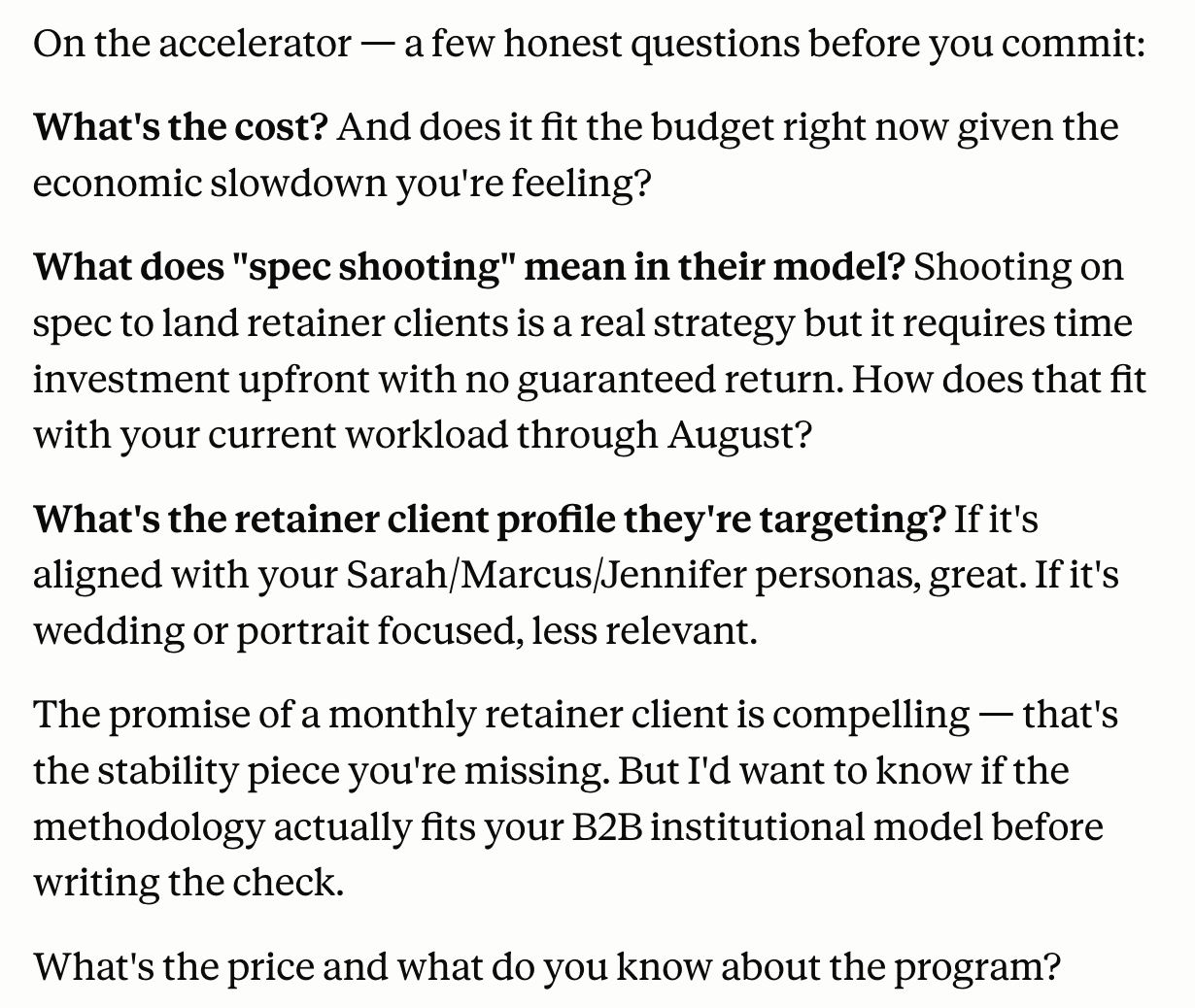
I will often use Claude to help me create marketing content. I will allow it to produce a first draft of my case studies, drawing on my sales assistant conversation and the project brainstorming session, and then it will interview me about the results. It produces a formatted starting point that I edit and finish. I’m a more long-winded storyteller (i.e., this blog post), and it does a better job of getting to the point for those pieces.
For highly formatted technical documents, I have used Claude to create call sheets and shot lists out of my existing project information. And I’ve also used Claude PowerPoint to create presentations out of my outlines and notes.
As an editor
I also use Claude as an editor. It outlines articles, finds themes in interviews, checks for redundancy, reviews design layouts, or helps me choose between image options. This replaces the newsroom colleague I used to turn to every day. That back-and-forth is vital, and Claude always has something useful to push back on. And I can ignore it if I want.
Technical photography tools: Aftershoot and Adobe
Outside of Claude, I also use Aftershoot, Adobe Lightroom Classic and Photoshop to edit my photos. All of these tools have had some form of “AI” in them for many years.
Aftershoot uses machine learning for culling — it finds in-focus subjects, open eyes, and smiles. Great for events, not great for portraits where subtle expressions matter. But it still saves me an hour or two and gets me 90% of the way there.
Lightroom and Photoshop use subject recognition to quickly mask parts of an image for editing. You really can’t do this work without them anymore when clients expect 50-100 photos per shoot.
The AI remove tool is great for stray hairs or distracting objects. I find it troubling that it can erase people or entire objects, but that’s the standard now in commercial work. I use it conservatively, but I accept it’s part of modern photography.
What I will NOT use AI for in my business
Will not use it for client-facing writing
Outside of the brainstorming and editing, I don’t use AI to generate articles or other writing for my clients, especially the magazines I write for. Writing is hard work on purpose. People hire me for my voice, interview skills, and experience — not for AI-generated copy. There’s no value in faking that.
It often takes me up to 8 hours to write a long-form magazine article (not to mention interviews, travel, etc.), and that’s the whole point. Why bother doing this work if a computer can do it for me?
Will not use it to generate images
I’ve used AI to generate images once when the client assignment was specifically to create something illustrative using both data and to capture the vibe of the Truckee Meadows region. We wrote a small essay about it for the publication and showed other examples. There was no attempt to pass it off as a hand-drawn illustration.
Generative images in photography are deeply troubling, lack soul, and quickly become unethical. The majority of examples seen online are AI-slop images passed off as real moments in time, used to dupe readers. That is the antithesis of photography and storytelling. Our entire purpose is to capture real moments of real people (or things). And generating a fabrication of that is too far for me.
It also defeats the purpose of doing the work and erodes trust.
I’m not opposed to AI art for actual artists (including art photography) if the artist is clear about their use, and it’s their style. That’s different from AI-slop passed off as photojournalism or documentary.
There is a great, bad example of what I’m talking about on TikTok, where a magazine used 100% AI-generated images of fashion “models” and skincare “models” throughout the “Beauty Authority” issue. It’s bad enough that the beauty magazine industry has been damaging women’s self-image for 50 years with “regular” photo manipulation, but now we don’t even have to start with real people. Those AI tools are trained on decades of manipulated images, and it goes against everything we’ve tried to do in the last 20 years to combat that trend.
And this is why I selected Claude, because it does not generate images other than data visualizations.
So what’s the point of AI then?
In my uses, AI doesn’t really save me much time, and in fact, it can often take more time to type through ideas or concepts and explain them to Claude. My chat sessions are like a series of interns straight out of college. They are full of information and eager to please, but they need a lot of direction on execution.
For me, the goal is to force me to think harder, answer questions, and work through ideas. It can help me feel more confident or accomplish some things faster or at least more thoughtfully.
I’m all by myself, and I need that back-and-forth to be creative. Claude helps me stay consistent in my approach and processes.
But, I’m always steering the direction, making the choices, doing the editing, taking the photos, creating the graphics, and working with my clients. And it knows that and respects that. It doesn’t try to increase engagement or gamification. Many times it tells me to go work on something else, go have a weekend, or leave my desk.
And more importantly, the accountability for everything I create or say still falls on me, regardless of how it was made.
Claude acted as an editor for this post to make sure I didn’t get too in the weeds.